The anxiety is real. When a tool like AI can write code faster than you can type it, the natural question is, "Am I obsolete?" At Tizbi, we believe the answer is a resounding no.
Our All-In AI brand isn't a funeral for programming; it's a reality check that AI is a lever, not a substitute. It isn't generating less work for developers - it's creating higher-order, more meaningful, and yes, more rewarding work that only humans can do.
Table of Contents:
- How Does AI Elevate the Role of a Software Engineer?
- Are Programmers Turning Obsolete Because of AI?
- The Developer's Irreplaceable Role in the AI Lifecycle
- All-In AI Case Studies
- Is AI a Threat to Developer Jobs, or a Promotion?
- Conclusion: AI as a Promotion, Not a Replacement
How Does AI Elevate the Role of a Software Engineer?
AI takes on the programming tasks we were already trying to automate away: the tedious syntax, the boilerplate setup, and the basic, repetitive debugging.
What remains is the truly creative core of development: problem definition, complex architecture, cross-system integration, and ethical governance. We don't want engineers spending all day Googling obscure error codes; we want them tackling million-dollar business problems.
AI frees them to do just that.
Are Programmers Turning Obsolete Because of AI?
There's a misconception that once AI can draft code, we won't need programmers anymore. To borrow a framing from Andrej Karpathy - this is like thinking that because calculators exist, mathematicians became outdated.
In truth, the opposite happened: the tools elevated the practice.
Programmers will not disappear; they'll evolve into System Architects, AI Conductors, and, most importantly, Business Value Engineers. They shift from being code typists to system shapers and strategic leaders.
Elon Musk has said that AI is like "summoning the demon", but the pragmatic takeaway isn't fear: it's discipline.
Just as with electricity or spaceflight, the question isn't if we use it, but how responsibly we direct it. And that direction comes from developers, who ensure AI systems don't just run, but run with guardrails, governance, and purpose.
The Developer's Irreplaceable Role in the AI Lifecycle
The All-In AI Process
Our AI adoption framework is intentionally human-driven because the hardest problems require human judgment. AI can map patterns and even bootstrap solutions, but it doesn't understand context, ethics, or long-term risk.
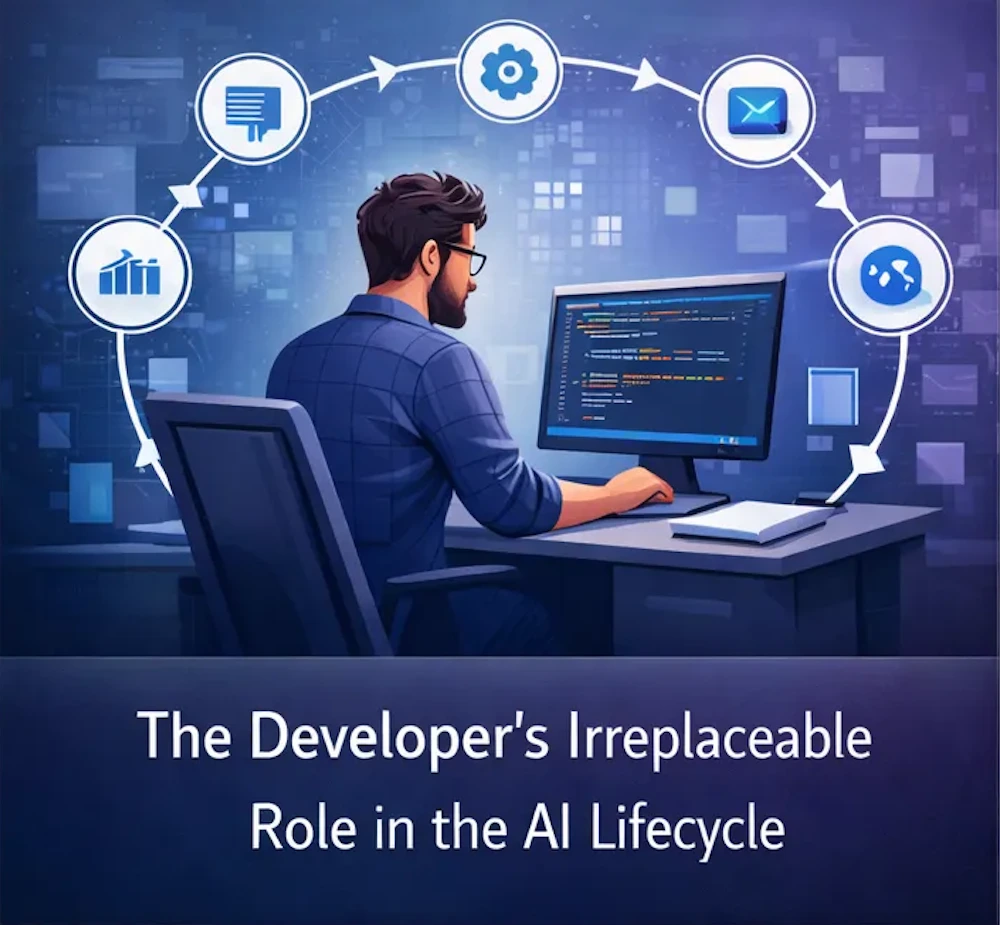
- In Strategy & Roadmap, developers don't just define guardrails; they apply ethical reasoning to ensure the AI should be doing a task.
- In Pilot Design, they stress-test assumptions and inject real-world nuance to prevent harmful bias or "hallucinations."
- In Implementation & Scaling, they harden integrations and establish the security posture, becoming the final, essential human overseer of the entire system.
- In Cultural Shift, they guide teams in working with AI as a colleague, serving as the crucial interpreters between the machine's output and the team's goals.
Every step increases the developer's accountability and impact, not lessens it.
All-In AI Case Studies
In every successful AI project, the programmer transforms the AI's output into a reliable, integrated system.
Call Rail Editor — From Data Mover to Insights Architect
AI extracts and analyzes call data. The developer's job is to make that data actionable. They build custom mapping, integration layers, and data checks to transform a flood of AI-generated text into a reliable, personalized action list for sales teams. The programmer transforms raw AI output into a business asset.
Sellnetics — From Draft to Distinction
AI drafts outreach. The developer's work is where the magic happens: personalization, optimization, and refining the models to hit a moving target. They are the ones engineering the distinction between generic, discarded spam and a high-converting message. The programmer turns an AI sketch into a profitable system.
In both cases, the AI did the groundwork. The programmers made it usable and profitable.
Is AI a Threat to Developer Jobs, or a Promotion?
Karpathy once described "vibe coding" as a future where developers express high-level intent, and AI scaffolds the rest.
This shift doesn't shrink the role of programmers; it amplifies their mastery. It shifts their time from the drudgery of typing syntax and basic debugging to steering entire systems, shaping ethical architectures, and making the complex judgment calls that only a human mind can make.
At Tizbi, our All-In AI approach isn't a threat; it's a promotion for our dedicated development teams.
We're betting on a future where programmers can finally focus on what they've always wanted to do: solving the biggest, most rewarding problems, and helping our clients obtain the best possible software products.
Conclusion: AI as a Promotion, Not a Replacement
The rise of AI in software development isn't the end of programming — it's the beginning of a new chapter. Developers who embrace AI as a tool rather than fear it as a replacement will find themselves with more influence, more responsibility, and more meaningful work than ever before.
At Tizbi, we're committed to this vision through our All-In AI initiative. We believe the future belongs to developers who can orchestrate AI systems, not just write code. And we're building our teams and our products with that future in mind.

