Introduction

Your software project is in trouble. Deadlines have slipped. The budget is blown. Stakeholders are losing confidence. But here's what nobody tells you: most “failed” projects can be saved. The question is whether recovery is worth the investment — and how to do it right.
After 28 years of building software and rescuing projects others had given up on, we've learned that project failure usually isn't about technology. It's about process, communication, and decision-making. And those things can be fixed.
This guide will help you diagnose what's really wrong with your project, decide whether to save it or kill it, and implement a recovery plan that actually works.
Key Statistics:
- 70% — of IT projects fail to meet goals
- $260B — wasted annually on failed projects
- 75% — of projects can be recovered
Table of Contents
- Introduction
- Warning Signs: Is Your Project Failing?
- Key Failure Indicators
- The Danger Zone
- Root Causes: Why Projects Really Fail
- Unclear or Changing Requirements
- Poor Project Management
- Inadequate Technical Skills
- Unrealistic Expectations
- Technology Mismatch
- The Critical Decision: Save or Kill?
- When to Save the Project
- When to Kill the Project
- The Sunk Cost Trap
- The Recovery Process: Step by Step
- Step 1: Stop the Bleeding
- Step 2: Conduct an Honest Assessment
- Step 3: Define Minimum Viable Recovery
- Step 4: Restructure the Team
- Step 5: Fix the Process
- Step 6: Execute with Discipline
- Vendor Transition: When to Change Partners
- Signs You Need a New Vendor
- Transition Phases
- Critical Success Factors
- Case Study: Healthcare Platform Recovery
- Preventing Future Failures
- Project Health Indicators Checklist
- Early Warning System
- Frequently Asked Questions
- Key Takeaways
Warning Signs: Is Your Project Failing?
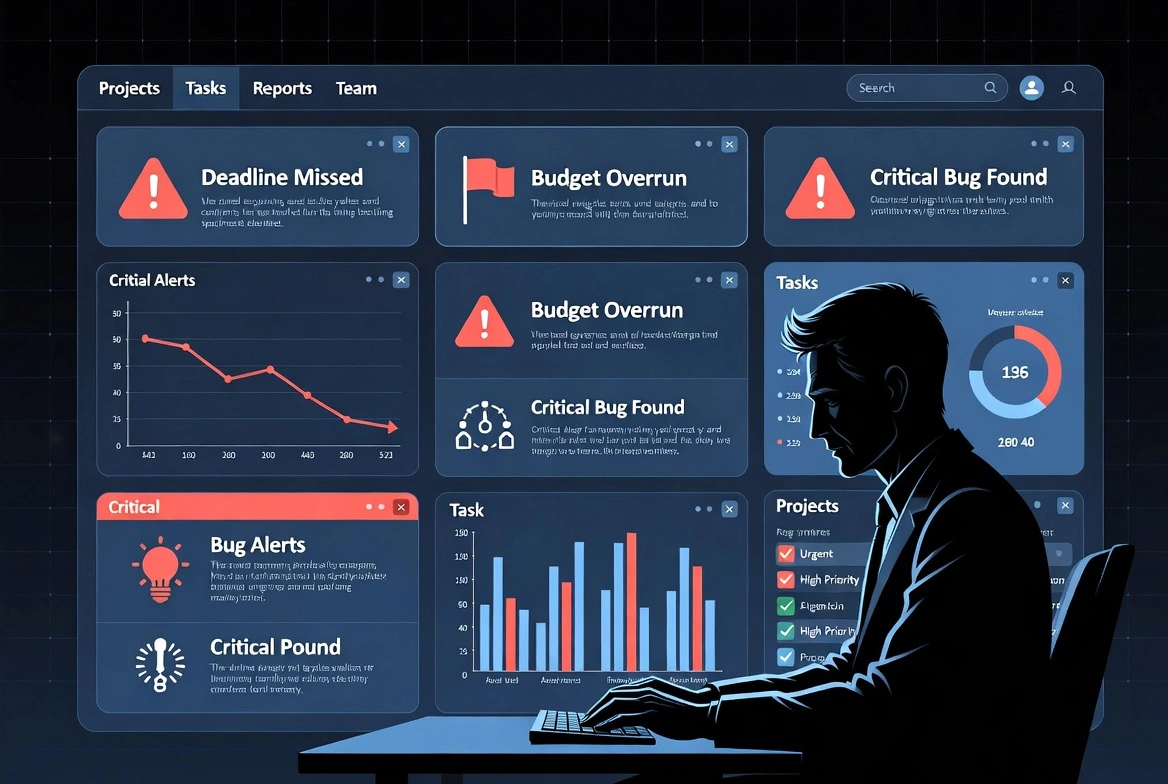
Projects rarely fail overnight. They deteriorate gradually, often while everyone involved tells themselves things will get better. Here are the warning signs that indicate your project is in serious trouble:
1. Missed Milestones
Multiple deadlines have slipped, and the new dates aren't based on realistic estimates.
2. Scope Creep
The project keeps getting bigger, but timeline and budget haven't adjusted.
3. Communication Breakdown
Status meetings are exercises in blame-shifting. Bad news is hidden or minimized.
4. Key People Leaving
Experienced team members are quitting or asking to be reassigned.
5. Quality Problems
Bugs are multiplying faster than they're being fixed. Testing is being skipped.
6. Stakeholder Conflict
Business and technical teams are at odds. Requirements keep changing.
7. Budget Overruns
You've already spent more than planned, with no clear path to completion.
8. Vendor Problems
Your development partner is unresponsive, missing commitments, or producing substandard work.
The Danger Zone
If three or more of these warning signs are present, your project is in serious trouble. The longer you wait to address it, the harder and more expensive recovery becomes.
Root Causes: Why Projects Really Fail

Technology is rarely the primary cause of project failure. In our experience rescuing dozens of stalled projects, the real causes fall into predictable categories.
37% of Failures: Unclear or Changing Requirements
The project started without clear definition of what success looks like. Stakeholders couldn't agree on requirements, or requirements kept changing without corresponding adjustments to timeline and budget.
Common symptoms: Feature creep, constant rework, stakeholder frustration, “that's not what I asked for” conversations.
25% of Failures: Poor Project Management
Lack of clear ownership, inadequate planning, poor communication, and failure to manage risks. Nobody is empowered to make decisions or hold people accountable.
Common symptoms: Missed deadlines with no consequences, status reports that hide problems, decisions that never get made.
18% of Failures: Inadequate Technical Skills
The team lacks the expertise needed for the chosen technology stack or the complexity of the problem. Architecture decisions were made without sufficient experience.
Common symptoms: Constant refactoring, performance problems, security vulnerabilities, “we didn't know it would be this hard.”
12% of Failures: Unrealistic Expectations
Timeline, budget, or scope were set based on what leadership wanted, not what was achievable. Teams were pressured to commit to impossible goals.
Common symptoms: Death march schedules, burned-out teams, quality shortcuts, everyone knew it would fail but nobody could say so.
8% of Failures: Technology Mismatch
The wrong technology was chosen for the problem — either too complex, too immature, or simply not fit for purpose.
Common symptoms: Fighting the framework, constant workarounds, vendor lock-in problems.
“Most failed IT projects don't fail because of technology. They fail because of people, process, and politics. Fix those, and the technology usually follows.”
The Critical Decision: Save or Kill?

Not every project should be saved. Sometimes the best business decision is to cut your losses. Before investing in recovery, honestly assess whether the project is worth saving.
When to Save the Project — Consider Recovery If:
- Business need still exists: The problem you're solving is still valuable to solve
- Core is salvageable: Significant work has been done that can be preserved
- Root causes are fixable: Problems are process/people issues, not fundamental flaws
- Stakeholder support remains: Leadership is willing to invest in recovery
- Sunk cost isn't the only reason: You'd still do the project if starting fresh
- Timeline is flexible: The business can wait for a proper recovery
When to Kill the Project — Consider Termination If:
- Business case has changed: The problem no longer needs solving, or a better solution exists
- Foundation is broken: Architecture is fundamentally flawed and can't be fixed incrementally
- Recovery cost exceeds restart: Starting over would be cheaper than fixing what exists
- Trust is destroyed: Relationships with vendors/stakeholders are irreparably damaged
- Talent has fled: Everyone who understood the system has left
- Technology is obsolete: You'd be recovering to an outdated platform
The Sunk Cost Trap
Don't let money already spent drive your decision. The question isn't “how much have we invested?” It's “given where we are today, what's the best path forward?” Sometimes the bravest and smartest decision is to stop.
The Recovery Process: Step by Step
Step 1: Stop the Bleeding
Before diagnosis or planning, stop making things worse.
- Freeze scope: No new features until the project is stabilized
- Pause commitments: Stop making promises about dates or deliverables
- Secure the team: Prevent further departures; bring in reinforcements if needed
- Communicate honestly: Tell stakeholders the project is in recovery mode
Timeline: 1-2 weeks
Step 2: Conduct an Honest Assessment
Diagnose the true state of the project without blame or defensiveness.
- Code review: Assess technical quality, architecture, technical debt
- Process audit: Examine how decisions are made, how work flows, where bottlenecks are
- Stakeholder interviews: Understand different perspectives on what went wrong
- Requirements review: Clarify what's actually needed vs. what's been built
- Team assessment: Evaluate skills, capacity, morale
Timeline: 2-4 weeks
Step 3: Define Minimum Viable Recovery
Identify the smallest possible scope that delivers business value.
- Prioritize ruthlessly: What features are absolutely essential?
- Cut to the bone: What can be deferred to a future phase?
- Define done: What specific, measurable outcomes constitute success?
- Estimate realistically: Build in contingency for inevitable surprises
Timeline: 1-2 weeks
Step 4: Restructure the Team
Align people and roles for recovery success.
- Clear ownership: One person accountable for recovery success
- Right skills: Fill gaps identified in assessment; remove people who aren't contributing
- External help: Bring in fresh perspectives — recovery specialists if needed
- Empowerment: Give the recovery team authority to make decisions
Timeline: 1-2 weeks
Step 5: Fix the Process
Implement governance that prevents the same problems from recurring.
- Short iterations: 1-2 week sprints with visible deliverables
- Daily standups: Surface problems immediately
- Clear escalation: Define how decisions get made when people disagree
- Transparent tracking: Everyone can see project status at any time
- Change control: Formal process for any scope changes
Timeline: Ongoing
Step 6: Execute with Discipline
Deliver incrementally, building confidence with each milestone.
- Quick wins: Prioritize early deliverables that demonstrate progress
- Quality first: No shortcuts — fix bugs before adding features
- Regular demos: Show working software to stakeholders frequently
- Adapt continuously: Adjust plan based on what you learn
Timeline: Until completion
Vendor Transition: When to Change Partners

Sometimes project failure is tied to a development partner who can't deliver. Changing vendors mid-project is risky but sometimes necessary.
Signs You Need a New Vendor
- Consistent pattern of missed commitments with no improvement
- Code quality is consistently poor despite feedback
- Communication has broken down beyond repair
- Key technical staff have been removed from your project
- Vendor is unresponsive to escalations
- Trust has been fundamentally broken
How to Transition Vendors Successfully
| Phase | Activities | Timeline |
|---|---|---|
| Assessment | New vendor reviews code, documentation, requirements | 2-4 weeks |
| Knowledge Transfer | Overlap period with both vendors; document tribal knowledge | 2-4 weeks |
| Stabilization | New vendor takes ownership; focuses on understanding before changing | 2-4 weeks |
| Recovery | Implement recovery plan with fresh team | Varies |
Critical Success Factor
The most important thing in a vendor transition is preserving knowledge. Insist on comprehensive documentation and direct access to outgoing developers during transition. What's in their heads is more valuable than what's in the code.
Case Study: Healthcare Platform Recovery
A healthcare company came to us with a patient portal project that had been in development for 18 months with nothing to show. The original vendor had quit, the budget was exhausted, and the board was considering cancellation.
What we found: Fundamentally sound architecture buried under poor code quality. Clear requirements that had been misunderstood. A demoralized internal team that knew what was wrong but hadn't been heard.
What we did: 3-week assessment. Reduced scope by 40%. Rebuilt team with 2 internal developers and 3 of ours. Implemented rigorous Agile process. Delivered weekly demos to rebuild stakeholder trust.
Results:
- 6 months — To production launch
- 60% — Of original budget
- 92% — User satisfaction
Preventing Future Failures
Once you've recovered a project, implement practices that prevent recurrence.
Project Health Indicators Checklist
- Clear, documented requirements with stakeholder sign-off
- Realistic timeline with built-in contingency
- Single accountable owner with decision authority
- Regular demos of working software (at least bi-weekly)
- Automated testing with high coverage
- Continuous integration and deployment
- Transparent status reporting (no hidden problems)
- Formal change control process
- Regular retrospectives with real improvements
- Team morale and turnover monitoring
Early Warning System
Establish triggers that force escalation and intervention:
- Two missed milestones = Mandatory project review
- 20% budget variance = Executive notification
- Key person departure = Knowledge transfer and backfill plan
- Stakeholder conflict = Facilitated resolution within 1 week
- Quality metrics declining = Stop and fix before continuing
Frequently Asked Questions
How common is it for IT projects to actually fail?
About 70% of IT projects fail to meet their original goals, timeline, or budget, and failed projects waste an estimated $260 billion annually. The good news: roughly 75% of stalled projects can be recovered rather than scrapped entirely, so failure at this stage isn't usually a dead end.
What's the single most common reason software projects go off track?
Unclear or constantly changing requirements account for 37% of project failures, more than any other cause. Poor project management (25%) and inadequate technical skills (18%) follow. Most failures trace back to a foundational planning gap, not a technology problem.
How many warning signs mean a project is in real trouble?
Watch for missed milestones, scope creep, communication breakdown, key staff departures, quality problems, stakeholder conflict, budget overruns, and vendor issues. Three or more of these happening at once puts a project in the danger zone and signals it's time for an honest, structured assessment rather than continuing on hope.
What is the sunk cost trap, and why does it lead to bad decisions?
The sunk cost trap is the tendency to keep funding a failing project because of what's already been spent, rather than what it will cost to finish or replace. Money already spent shouldn't factor into whether to save or kill a project - only the cost and value of what's left to do should.
Is it usually cheaper to recover a failed project or start from scratch?
It depends on whether the recovery cost exceeds the cost of a full restart - one of the core criteria for deciding to kill rather than save a project. A salvageable core, fixable root causes, and continued stakeholder support all tip the calculation toward recovery being the cheaper path.
How long does a typical IT project recovery take from start to finish?
The structured recovery process runs through six steps, each taking roughly 1-4 weeks: stopping active damage, an honest assessment, defining a minimum viable recovery scope, restructuring the team, fixing the underlying process, and disciplined execution. Total timeline varies with project size, but most phases move in weeks, not months.
How do you know if the real problem is the vendor rather than the project itself?
Persistent vendor problems, missed commitments, and eroded trust are signs the issue sits with the partner, not just the project plan. Vendor transitions typically run through assessment, knowledge transfer, and stabilization phases, each 2-4 weeks, so switching partners is a real option, not just a last resort.
Key Takeaways
- Most failures are recoverable: With the right approach, 75% of troubled projects can be saved
- Technology isn't the problem: Process, communication, and decision-making cause most failures
- Honest assessment first: You can't fix what you haven't diagnosed
- Save vs. kill is a real choice: Sometimes stopping is the right decision
- Scope reduction is essential: Successful recovery almost always means doing less
- Process discipline matters: Short iterations, visible progress, clear accountability
- Don't go it alone: Fresh perspectives and specialized expertise accelerate recovery
Tizbi — Rescuing stalled software projects for over 28 years. Contact us today.