
AI is no longer a futuristic concept. It's a competitive necessity. But the gap between “we need AI” and successful implementation is where most enterprises stumble. This guide cuts through the hype to show you exactly how to implement AI that delivers measurable business value.
According to Gartner, only 54% of AI projects make it from pilot to production. The rest fail due to unclear objectives, poor data quality, lack of executive sponsorship, or choosing the wrong use cases.
After implementing AI solutions for enterprises across healthcare, financial services, manufacturing, and technology for over two decades, we've identified the patterns that separate successful AI initiatives from expensive experiments.
- 54% of AI pilots reach production
- 3-5x ROI on successful implementations
- 6-18 months to measurable results
Table of Contents
- Understanding AI Readiness: Where to Start
- Selecting the Right AI Use Cases
- Generative AI and ChatGPT Integration
- Evaluating AI Consulting Partners
- Enterprise AI Implementation Roadmap
- Common Pitfalls in AI Implementation (And How to Avoid Them)
- Measuring AI Success
- Frequently Asked Questions About Enterprise AI
- Key Takeaways for Business Leaders
- How Tizbi Supports Enterprise AI Implementation
Understanding AI Readiness: Where to Start
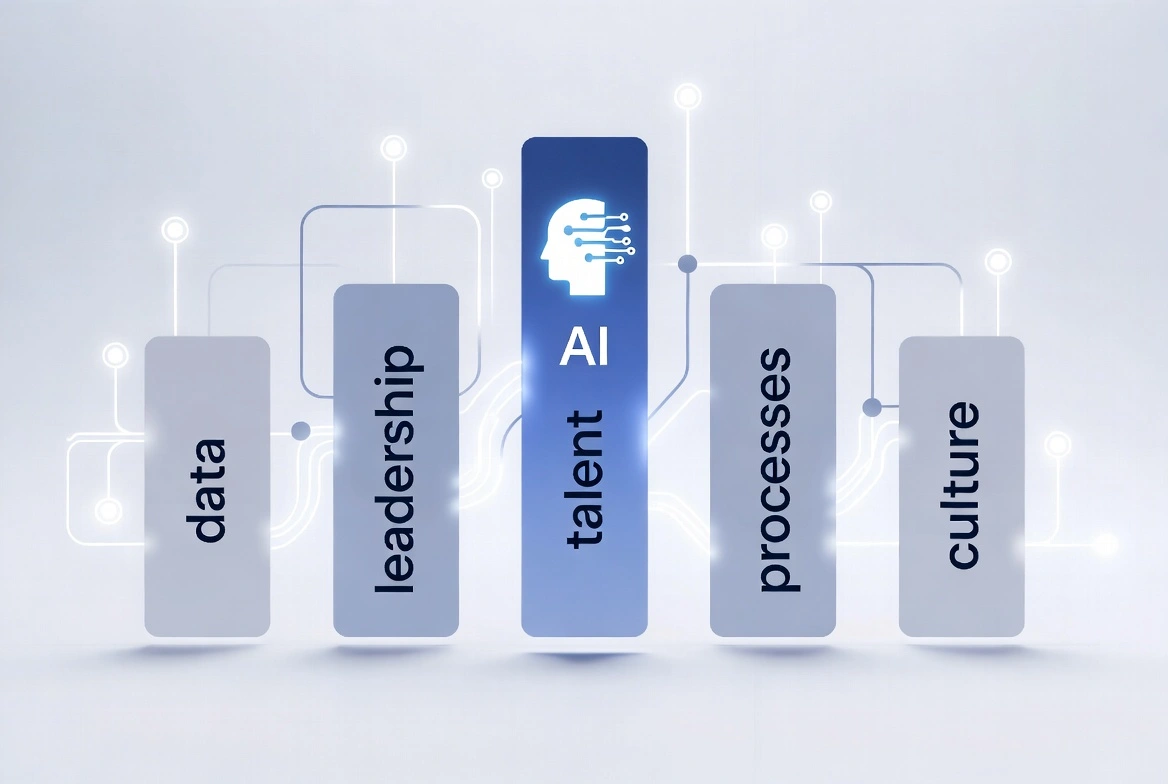
Before selecting vendors or technologies, you need to honestly assess your organization's readiness for AI. This isn't about whether AI is right for your industry — it almost certainly is. It's about whether your organization can successfully adopt it today.
The Five Pillars of AI Readiness
1. Data Infrastructure
AI is only as good as the data that feeds it. Ask yourself:
- Is your data centralized or scattered across siloed systems?
- Do you have clean, labeled datasets for the processes you want to improve?
- Can your current infrastructure handle the computational demands of AI?
- What's your data governance situation — who owns what?
2. Executive Sponsorship
AI projects without C-suite backing rarely succeed. You need:
- A champion who understands both business objectives and AI capabilities
- Budget commitment beyond the pilot phase
- Willingness to drive organizational change
- Patience — AI isn't a quick fix
3. Talent & Skills
You don't need to hire a team of data scientists immediately, but you need:
- Technical staff who can work with AI vendors and maintain solutions
- Business analysts who can translate problems into AI opportunities
- Change management capability to drive adoption
4. Process Maturity
AI amplifies existing processes — good or bad. Consider:
- Are your core business processes documented and standardized?
- Do you measure process performance with clear KPIs?
- Have you identified bottlenecks and inefficiencies?
5. Cultural Readiness
AI changes how people work. Assess whether your organization:
- Embraces or resists technology change
- Has successfully adopted new technologies in the past
- Can address employee concerns about AI replacing jobs
Quick AI Readiness Check
If you have centralized data, executive buy-in, and at least one clear use case with measurable outcomes, you're ready to start. If you're missing multiple elements, consider a smaller pilot or address foundational gaps first.
Selecting the Right AI Use Cases

The biggest mistake organizations make is choosing AI use cases based on what's technically impressive rather than what delivers business value. The best first AI project isn't necessarily the most innovative — it's the one most likely to succeed and build organizational confidence.
High-Impact, Achievable First Projects
| Use Case | Complexity | Impact | Best For |
|---|---|---|---|
| Document Processing | Low-Medium | High | Legal, healthcare, finance |
| Customer Service Chatbots | Medium | Medium-High | High-volume support centers |
| Predictive Maintenance | Medium | High | Manufacturing, facilities |
| Demand Forecasting | Medium | High | Retail, supply chain |
| Fraud Detection | Medium-High | Very High | Financial services |
| Process Automation (RPA+AI) | Low-Medium | Medium | Any repetitive back-office |
Use Case Selection Criteria
Score potential use cases on these factors:
- Business Value: What's the potential ROI? Can you quantify it?
- Data Availability: Do you have the data needed to train and run the model?
- Technical Feasibility: Is this a solved problem or cutting-edge research?
- Organizational Impact: How much change management is required?
- Time to Value: How quickly can you see results?
- Risk Tolerance: What happens if it fails?
Common Red Flags in Use Case Selection
Avoid projects where success metrics are vague (“improve efficiency”), required data doesn't exist yet, the use case requires 100% accuracy (AI is probabilistic), or stakeholders expect immediate, dramatic results.
Generative AI and ChatGPT Integration
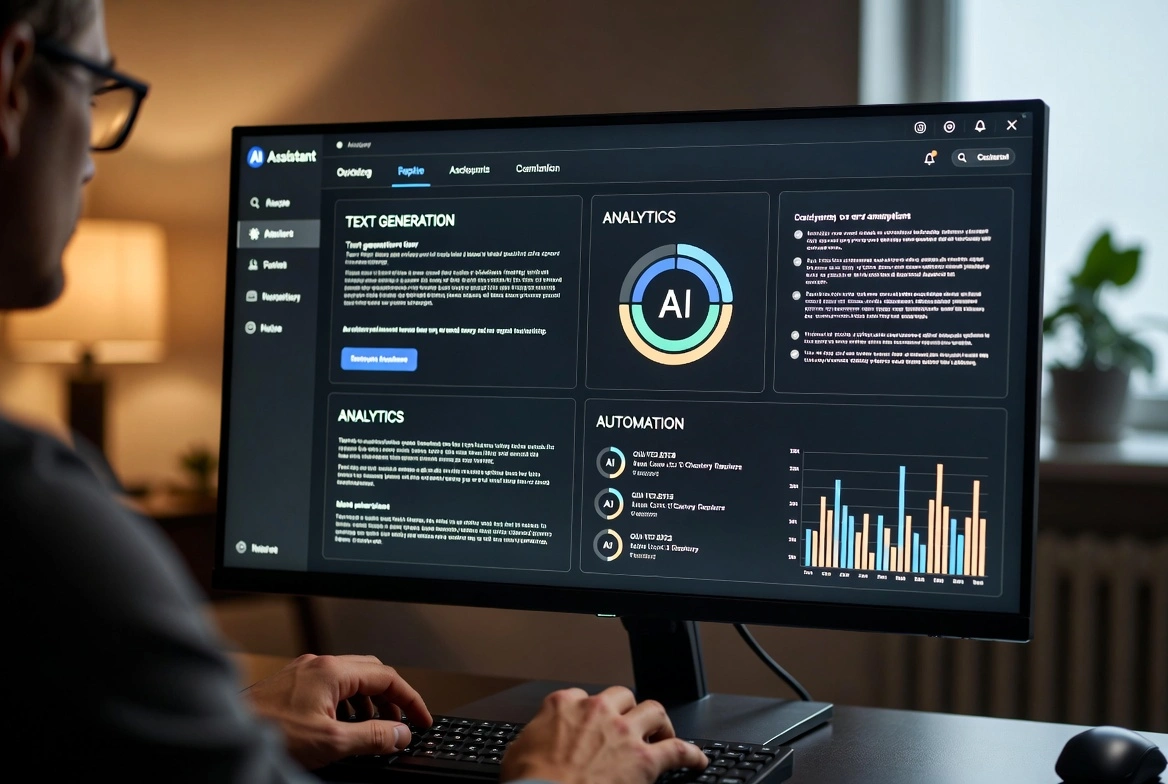
The explosion of generative AI has created new opportunities — and new confusion. Let's be clear about what generative AI can and can't do for enterprise applications.
Enterprise Applications of Generative AI
- Content Generation: Marketing copy, reports, documentation drafts
- Code Assistance: Developer productivity tools, code review, documentation
- Knowledge Management: Internal Q&A systems over company documents
- Customer Communication: Email drafts, response suggestions, chat support
- Data Analysis: Natural language queries against databases
- Training & Onboarding: Interactive learning assistants
Data Privacy and Security Considerations
Enterprise data cannot flow to public AI models. Solutions include:
- Private cloud deployments (Azure OpenAI, AWS Bedrock)
- On-premise models for sensitive industries
- Data anonymization before AI processing
- Clear policies on what data can be used with AI
Managing Accuracy and Hallucinations
Generative AI can produce confident-sounding but incorrect outputs. Mitigate with:
- Retrieval-Augmented Generation (RAG) grounded in your data
- Human-in-the-loop review for critical outputs
- Fact-checking workflows before customer-facing use
- Clear disclaimers where appropriate
“The organizations getting the most value from generative AI aren't asking 'what can AI do?' They're asking 'what specific problems can AI solve for us, and how do we measure success?'”
Evaluating AI Consulting Partners
Whether you're building AI capabilities in-house or working with partners, choosing the right consulting firm is critical. Here's how to evaluate potential partners.
Key Questions to Ask AI Vendors
- What's your smallest successful AI project? (Reveals if they can right-size solutions)
- Which AI projects have you killed or advised against? (Shows they prioritize fit over sales)
- What shouldn't be solved with AI? (Tests their strategic thinking)
- How do you handle data that doesn't exist yet? (Common reality check)
- What's your approach to change management? (Technology is only half the battle)
- Can you share references in our industry? (Domain expertise matters)
- How do you structure knowledge transfer? (You shouldn't be dependent forever)
- What happens when the project “fails”? (Reveals risk-sharing philosophy)
Red Flags in AI Consulting Firms
- Promises of quick, dramatic results without understanding your data
- One-size-fits-all solutions regardless of your specific needs
- Reluctance to discuss failed projects or limitations
- Heavy focus on technology without business outcome discussion
- No clear methodology for measuring success
- Inability to explain AI concepts in business terms
Enterprise AI Implementation Roadmap
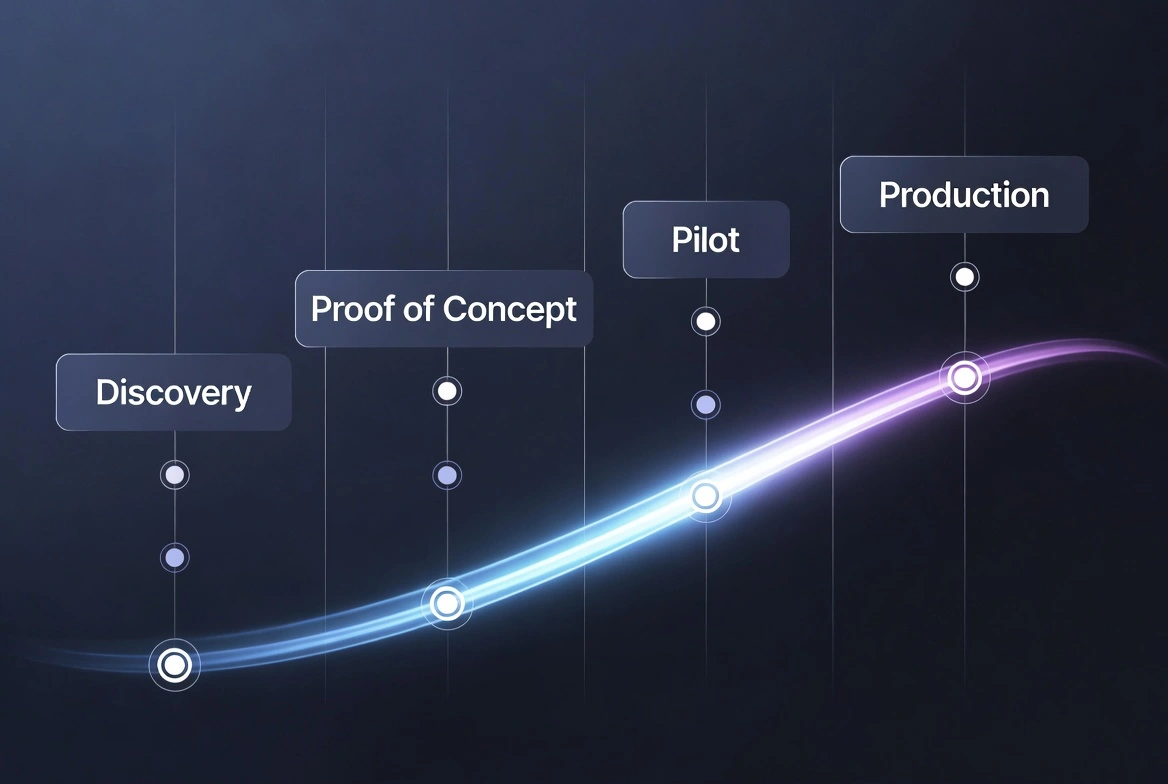
A successful AI implementation follows a structured approach. Here's the roadmap we recommend:
Phase 1: Discovery & Strategy (4-6 weeks)
- Document current state and pain points
- Identify and prioritize use cases
- Assess data readiness
- Define success metrics and KPIs
- Build business case and secure sponsorship
- Select technology approach
Phase 2: Proof of Concept (6-12 weeks)
- Build MVP for highest-priority use case
- Test with real (but limited) data
- Validate technical feasibility
- Measure preliminary results
- Gather user feedback
- Refine approach based on learnings
Phase 3: Pilot Deployment (8-16 weeks)
- Deploy to limited production environment
- Train initial user group
- Monitor performance and accuracy
- Iterate based on real-world feedback
- Document processes and learnings
- Build change management plan
Phase 4: Production & Scaling (Ongoing)
- Full production deployment
- Organization-wide training
- Continuous monitoring and improvement
- Expand to additional use cases
- Build internal AI capabilities
Timeline Expectations
Plan for 6-18 months from kickoff to measurable production results, depending on complexity. Organizations that try to compress this timeline often end up taking longer due to rework and failed pilots.
Common Pitfalls in AI Implementation (And How to Avoid Them)
Starting Too Big
The Problem: Attempting to transform the entire organization with AI at once.
The Solution: Start with one well-defined use case. Prove value, learn, then expand.
Ignoring Data Quality
The Problem: Assuming existing data is ready for AI consumption.
The Solution: Budget time and resources for data cleaning, labeling, and preparation. This often takes 60-80% of project time.
Technology-First Thinking
The Problem: Choosing AI technology before defining business problems.
The Solution: Start with business outcomes, then select appropriate technology.
Underestimating Change Management
The Problem: Building great AI that nobody uses.
The Solution: Involve end users from day one. Address concerns about job displacement directly. Make adoption easy.
Lack of Clear Success Metrics
The Problem: Inability to prove value or justify continued investment.
The Solution: Define measurable KPIs before starting. Track baseline, pilot, and production performance.
Measuring AI Success
AI projects should be measured like any other business initiative — by their impact on business outcomes.
Key Metrics by Use Case Type
| AI Application | Primary Metrics | Secondary Metrics |
|---|---|---|
| Process Automation | Time saved, cost reduction | Error rate, employee satisfaction |
| Customer Service AI | Resolution rate, handle time | CSAT, escalation rate |
| Predictive Analytics | Prediction accuracy, decision quality | Revenue impact, cost avoidance |
| Content Generation | Time to create, output volume | Quality scores, revision rates |
Frequently Asked Questions About Enterprise AI
How much does enterprise AI implementation cost?
Costs vary widely based on complexity. A focused proof of concept might run $50,000-$150,000. Full production implementations for complex use cases can range from $250,000 to $2M+. The key is starting small, proving value, then scaling investment.
Do we need to hire data scientists?
Not necessarily for your first projects. Many implementations can leverage pre-built AI services and external partners. As AI becomes core to your operations, building internal capability makes sense — but it's not a prerequisite to getting started.
How do we handle employee concerns about AI replacing jobs?
Address this directly and honestly. Most AI augments human work rather than replacing it entirely. Focus messaging on AI handling repetitive tasks so employees can focus on higher-value work. Invest in reskilling and clearly communicate how roles will evolve.
What about AI ethics and bias?
This is critical, especially for customer-facing or decision-making AI. Build bias testing into your development process, ensure diverse training data, maintain human oversight for consequential decisions, and establish clear governance policies.
Key Takeaways for Business Leaders
- Start with readiness: Assess data, sponsorship, talent, processes, and culture before diving in
- Choose use cases strategically: Prioritize achievable wins over impressive moonshots
- Plan for the long game: Expect 6-18 months to production results
- Data is everything: Budget 60-80% of project time for data preparation
- Measure relentlessly: Define success metrics before you start
- Don't neglect change management: Technology is only half the battle
- Partner wisely: Choose consultants who understand business outcomes, not just technology
How Tizbi Supports Enterprise AI Implementation
Tizbi has been helping enterprises implement technology solutions for over 28 years. Our AI consulting team can help you assess readiness, select the right use cases, and build solutions that deliver real business value. When success depends on the systems around your models, our team can also build custom software tailored to those workflows. Explore our All-In AI practice or schedule a free AI consultation.